Stop Stuffing Your Context Windows (Do This Instead)
Why RAG is still beating massive context windows for real-world apps plus the exact decision framework to cut your token costs.
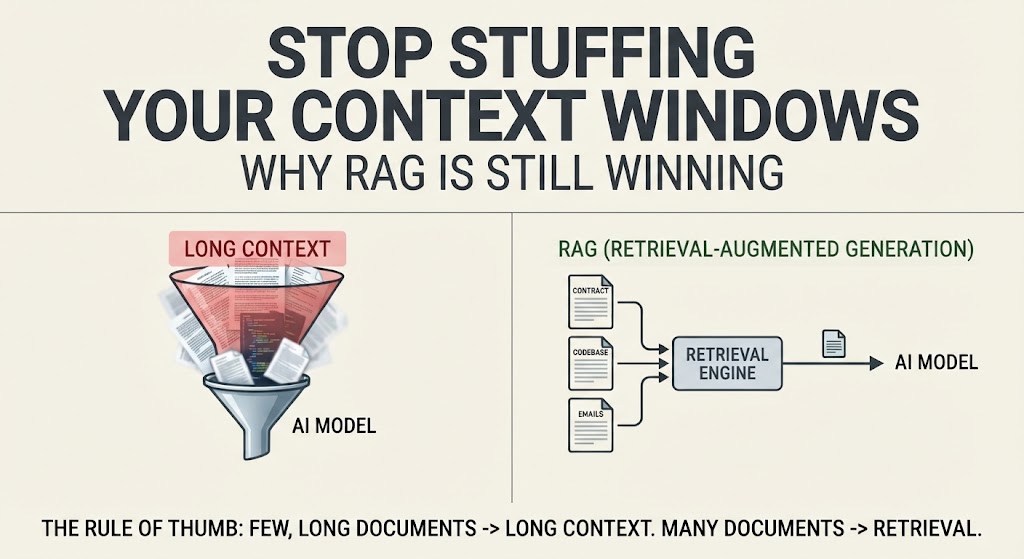
Here is the counterintuitive answer most articles skip: a giant context window is a gift you should use sparingly, because for many real workloads “retrieve the relevant bits first” is still cheaper, faster and more accurate than stuffing everything in. Yes, modern models can read a small novel’s worth of text in a single go that is genuinely useful for one long contract or a few documents side by side. But when you have hundreds of documents and only need a handful of relevant passages, pumping them all into context wastes money, slows responses and often degrades accuracy on the very thing you care about. The skill is knowing which situation you are in. This guide gives you the decision rule, explains the real costs people underweight, and shows you how to test which approach wins for your own data.
What a big context window actually is
A “context window” is the amount of input a model can process in a single call. “Context windows got huge” is a statement of fact about the direction of the market: the maximum input size of leading models has grown dramatically over a short number of years, so “too big to process at once” is far rarer than it used to be.
Why that matters: a large context window means the model can hold and reason over a very large input at once. No chunking. No step-by-step retrieval. No “sorry, this file is too big.” You hand it the whole thing and it answers. For the tasks below, that is exactly the right tool.
The genuine sweet spots:
- Reviewing a single long contract end to end the answer depends on details scattered across the whole document, and you want the model to see all of them at once.
- Comparing a handful of documents side by side a few NDAs, two vendor proposals, a policy and its amendment.
- Working through a large codebase in one pass understanding how modules interact across many files.
- Any task where subtle, scattered detail decides the answer the kind of thing that gets lost or dropped when you slice the input into pieces.
For these, a big window is simple and correct: you get the full picture in one shot, no retrieval infrastructure, no second system to maintain.
When retrieval is the better choice
Retrieval often called RAG, short for retrieval-augmented generation flips the process. Instead of feeding everything to the model, you first find the few relevant passages from a larger collection, then feed only those to the model. It shines in three situations:
- Lots of documents, few relevant at a time. When your collection is large (a whole document library, a support knowledge base, a year of emails) but any single question only involves a handful of passages, retrieval avoids paying to process everything on every call.
- A living corpus that changes. If your documents change regularly weekly updates, new versions, a growing archive you cannot just “stuff it all in” each time anyway. Retrieval queries the freshest source and gets the current answer.
- Cost- and latency-sensitive applications. You pay per token. Processing only what matters is dramatically cheaper and faster than billing the whole collection on every request. In high-volume or agent-style workloads (where the model is called repeatedly), this difference compounds fast.
The common framing “long context vs RAG” is slightly misleading, because they are not rivals; they are two tools for two situations. The real question is always: how big is the input, and how much of it actually matters for this answer?
| Situation | Better approach | Why |
|---|---|---|
| One long contract | Long context | Full picture; no slicing to lose detail |
| A few documents to compare | Long context or retrieval | Either works; size decides |
| Hundreds of files, few relevant | Retrieve first | Cheaper, faster, more accurate |
| A library that changes weekly | Retrieve first | Always fresh; cannot fit it all anyway |
| Huge corpus with subtle scattered detail | Test both | Retrieval can miss it; measure before trusting |
| High-volume or repeated calls | Retrieve first | Token costs compound across many calls |
The real costs of “just use the big window”
Three costs get consistently underweighted, and they are the reason “bigger is always better” is wrong in practice:
- Money. Longer inputs cost more per request, and those costs scale silently across an entire team or workflow. What looks like a free convenience in a single demo becomes a real line item at volume.
- Latency. More input means slower responses. That is a minor annoyance in a single call but a major problem in an agent that calls the model many times per task, or in any interactive tool where users are waiting.
- Accuracy. More irrelevant content can actively distract the model. There is a well-documented phenomenon where flooding the context with noise content that has nothing to do with the question degrades the precision of the answer. “More context” is not automatically “better reasoning”; sometimes it is more noise to reason through.
None of these say the big window is bad. They say it is a costed choice, and you should know what you are paying before you default to it.
Why people over-reach with long context anyway
If retrieval is often the better tool, why do so many defaults keep reaching for the big window? The reasons are human and worth naming, because recognising them helps you resist them:
- It is easier to set up. Pumping a whole file into the model takes two lines. Building retrieval embeddings, an index, a query step takes real setup. Ease of implementation quietly biases teams toward long context even when it is not the efficient choice.
- It feels more complete. “The model saw the entire document” sounds like it must be more accurate than “the model saw five relevant passages.” In practice the opposite is often true: a focused prompt on the relevant passages answers better than a distracted model on the whole corpus.
- The demo looks good. A one-shot answer with no pipeline to maintain is a lovely demo. The costs tokens, latency, drift only show up at scale, after the decision is already made.
- It is what the marketing pushes. “Everything fits in context now” is a simpler, more exciting story than “you should build a retrieval pipeline.” Sales messages are not engineering advice.
None of these excuses the wrong tool; they explain why the wrong tool keeps winning the default. Deliberately asking “do I actually need all this in context, or just the relevant parts?” is the habit that keeps you on the cheap, accurate path.
The rule of thumb
- Few, long documents: use long context. It is the simple, correct answer no infrastructure, full picture.
- Many documents: retrieve first. Fetch only the passages you need and pay only for those tokens.
- High-volume or repeated calls: retrieve first, because token costs compound and latency matters.
- Always test on your own data. Benchmarks and marketing claims are no substitute for running your actual files through both approaches and comparing accuracy, speed and cost. The “right” answer for your workload is a fact, not an opinion and the only way to know it is to measure.
How to test (in an afternoon)
Do not guess. Run both approaches on a representative slice of your real data:
- Take a real task five to twenty of the actual questions you’d ask the model.
- Prepare two pipelines: one that stuffs full documents into context, one that retrieves the top few passages first (easy to trial with an off-the-shelf embedding/vector tool or a managed RAG service).
- Score outputs on accuracy of the answer, how much human checking they need, latency per question, and real cost per 1,000 questions.
- Pick the winner on the metrics that matter to you and note that for a big or changing corpus, the blended cost difference is usually decisive.
Most teams find the answer is “long context for the handful of big files, RAG for the archive” a mix, not a single winner.
Huge context windows are a real advance, not a gimmick. They remove a whole class of “too big to process” problems and make single-document deep-dives effortless. But they are one tool in a two-tool kit alongside retrieval, and the correct choice is situational: dump whole documents in when there are few of them and the detail matters; retrieve first when you have a large or changing corpus or you are making many repeated calls. Measure on your own data before you commit, because the cheapest and most accurate approach for your workload is an empirical fact and now you know exactly how to find it.
FAQ
Are large context windows always better? No. Long context is ideal for a few long documents, but for many documents where you only need a few passages, retrieval (RAG) is usually cheaper, faster and more accurate. Bigger context can also degrade precision if you flood it with irrelevant content.
What is the difference between long context and RAG? Long context feeds the whole input to the model at once. RAG (retrieval-augmented generation) first finds only the relevant passages and feeds those. Choose long context for few, long documents; choose RAG for many documents or a changing corpus.
What is RAG? Retrieval-augmented generation a pattern where you first retrieve the most relevant passages from a collection (often using embeddings and a vector index), then feed only those passages to the model. It keeps costs low and answers fresh when the corpus is large or changes.
Why is a bigger context window not always cheaper? You pay for tokens, so a larger input costs more per request. It also adds latency, and it can reduce accuracy when the extra content is irrelevant noise.
How do I decide between long context and retrieval? Use long context for few, long documents; retrieve first for many documents or high-volume repeated calls. Always test both approaches on your own data and compare accuracy, speed and cost.
(Keep reading)